AMD launches Ross, an agentic AI assistant for embedded engineers
AMD Ross connects natural-language agents to AMD's embedded toolchains, with reusable expert-authored skills and MCP-based tool access, starting with Vivado and Vitis HLS.
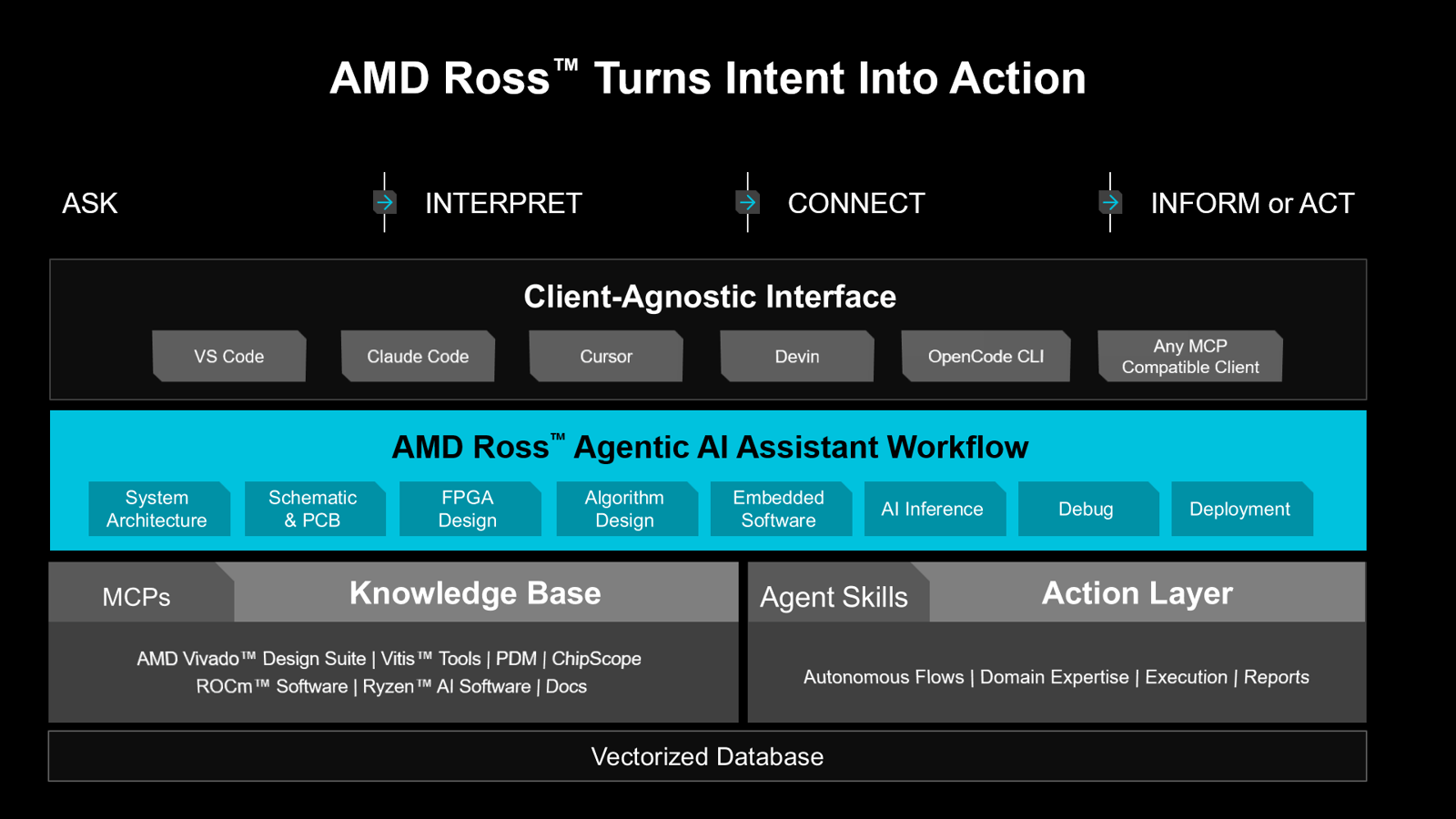
AMD has launched Ross, an agentic AI assistant aimed at embedded developers. Introduced Thursday, Ross is designed to carry engineers from initial system architecture through optimization, debugging, and deployment, using natural-language interaction plus reusable, expert-authored workflows.
The notable part is where it points the agents. Rather than stopping at code completion, Ross plugs into AMD's embedded toolchains across hardware, software, AI, and board design: FPGAs, adaptive SoCs, x86 embedded processors, and edge AI platforms. Tasks AMD lists include hardware and software partitioning, high-level synthesis, machine-learning optimization, power estimation, schematic review, and debugging real hardware.
Four pieces under the hood
Ross is not a model. It is an assistant layer built from four components: MCP servers that connect agents to AMD embedded tools, an AMD-validated knowledge base of user guides and application notes, agent skills stored as open Markdown files that capture expert workflows, and ready-to-run design examples. An engineer can ask in plain language to search documentation, check tool status, run commands, or execute a proven workflow such as timing optimization or restructuring C++ for Vitis HLS.
It is also client-agnostic: Ross works with the developer's preferred model, IDE, and command-line environment, and AMD names VS Code, Cursor, Devin, Claude Code, Copilot CLI, and Codex CLI as examples. AMD says permissions stay with the user, with human review gates at planning and execution.
What it supports at launch
The initial release covers the Vivado Design Suite and Vitis HLS. AMD plans monthly releases from here, and its broader support matrix includes ChipScope, Power Design Manager, Vitis AI, ROCm AI, and Ryzen AI software. Ross requires no additional license beyond the AMD tools a team already uses, though engineers still need access to their chosen model.
"AMD Ross brings AMD Embedded tools, trusted knowledge and expert-authored workflows together in a single agentic AI experience grounded in the technologies and methodologies our customers use every day," said Salil Raje, senior vice president and general manager of AMD Embedded.
Early user iWave Global gets a quote in the announcement: associate director Geetha Govindaraj said Ross helped her FPGA system-on-module team "identify and troubleshoot issues more efficiently, reducing the time and effort required during the debugging and bring-up stages."
AMD Ross is available now through AMD.com/Ross, with the full announcement at AMD's newsroom. One caveat from the launch coverage: AMD does not quantify expected time savings, so the "dramatically accelerating" framing is the vendor's claim until teams report back.