HackerRank makes Chakra, its AI interviewer that grades how engineers use AI, generally available
HackerRank has rolled Chakra, an AI agent that conducts technical interviews inside a real code canvas and scores how candidates think and use AI, out of beta after more than 500,000 test interviews.
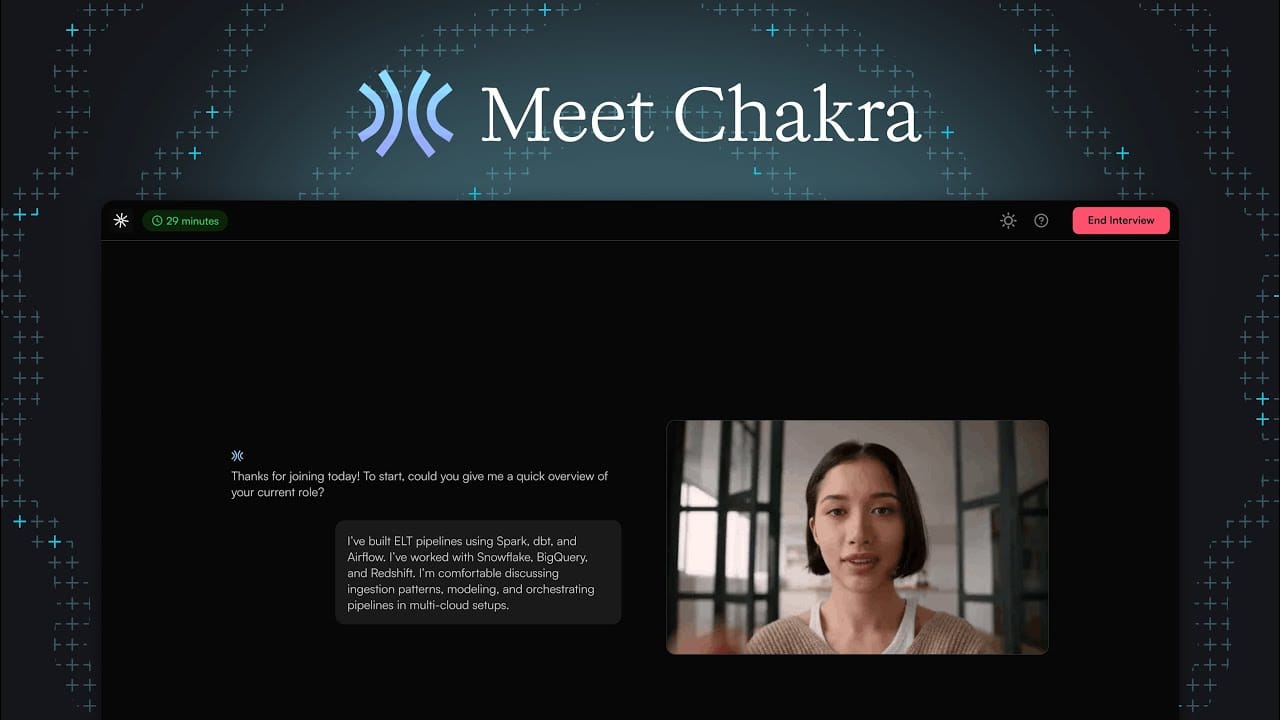
HackerRank is done beta-testing its AI interviewer. The hiring platform said Monday it is making Chakra generally available, after roughly six months of testing in which the company says the agent conducted more than 500,000 interviews, with Snowflake, Snorkel, and Capgemini among the early testers.
Chakra is HackerRank's answer to a problem its own product helped create. The company built its business on coding assessments that score the final answer. Now that candidates can have AI produce working code during an interview, the final answer says less about the candidate. "The previous modality of evaluation was evaluating the output," co-founder and CEO Vivek Ravisankar told TechCrunch. "Now, because of AI, anybody can produce an artifact."
Watching the process, not the product
So Chakra watches the process instead of just the product. A candidate gets a task tied to a real code repository and works inside a canvas that includes an embedded AI assistant. The agent observes the workflow in real time and asks contextual follow-up questions: why this approach, how the solution changes under new constraints. After the session, hiring teams receive a score plus a narrative of the candidate's reasoning. HackerRank positions it as a replacement for three separate stages, the recruiter screen, the take-home test, and the live engineering interview, collapsed into a single session.
What it claims to measure is broader than correctness. HackerRank says Chakra scores critical thinking and judgment along with what it calls "AI fluency": how well a candidate frames a problem for an AI tool, evaluates what comes back, and steers it toward a solution. The product page shows the kind of feedback hiring managers see, including blunt notes like: "The outcome is plausible, but the candidate did not show they understood or could defend what they accepted."
The integrity story is the most interesting vendor claim in the launch. HackerRank reports that suspicious-activity flags run 70% to 80% lower in Chakra interviews than in comparable traditional assessments. Ravisankar's argument is that once candidates are allowed to use AI openly, the incentive to cheat with hidden tools drops. The agent still watches for help it does not allow: HackerRank says it flags unauthorized apps, naming the interview-assistant tool Cluely specifically, along with help from a second device.
There are the usual caveats. The 500,000-interview figure, the flag-reduction stat, and the reported 4.8 out of 5 candidate rating all come from HackerRank itself and have not been independently verified. AI-led hiring also sits in regulated territory: HackerRank says Chakra is built to comply with requirements such as New York City's Local Law 144 on independent bias audits, and that it runs third-party bias analyses. Human hiring managers keep the final decision, the company says. HackerRank explains the product's mechanics in more detail in its writeup on how the interviewer works.
The broader signal is about what employers think is scarce now. When the code is cheap to produce, the scarce inputs are judgment about the code and fluency with the tools that produced it. Chakra is a bet that those are measurable in a single instrumented session. Whether candidates experience that as a fairer screen or a more invasive one will probably decide how far this goes.