Cursor launches Rollouts and Security Reviewer: bots that watch your code after the PR
Cursor launched Rollouts and Security Reviewer on September 23, AI bots that track changes from PR to production and scan every PR for vulnerabilities, available on Teams and Enterprise plans.
Cursor is moving its AI into the part of software development that happens after the code is written.
On September 23, the company launched two bots: Rollouts, which follows a code change from pull request to production and watches whether it behaves as intended, and Security Reviewer, which scans every PR for vulnerabilities and proposes fixes. Both are available now on Cursor's Teams and Enterprise plans, enabled from the automations tab. Cursor
Rollouts: a bot that watches production, not pull requests
Most AI coding tools focus on the writing phase. Rollouts starts where they stop. You connect source control, your deploy system, and your telemetry (Datadog, Grafana, Honeycomb, or wherever your metrics and traces live). Before merge, Rollouts reads the diff and writes a monitoring plan: the risks it sees, the effects the change is supposed to have, and the places your instrumentation cannot tell you whether it worked. You can edit the plan if it is missing something.
After deploy, the bot compares the signals in the plan against the pre-deploy baseline. When it finds a regression, it names the change it suspects and says what it plans to do. Depending on your configuration, that means a ping to the author, a paused progressive rollout, or a revert PR waiting for approval.
Cursor says Rollouts is good at three things today: catching regressions confined to one endpoint in one region before a global alert would fire, telling intended effects apart from regressions so a deliberate spike does not page anyone, and flagging missing instrumentation before merge, which Cursor calls the most common reason a bad change goes unnoticed. Feature flag integration and awareness of release trains and deploy freezes are in development.
Security Reviewer: review with attack paths
Security Reviewer runs on every PR and reads the change in the context of the whole codebase. Instead of pattern-matching like static analysis, it works the way Cursor describes a security engineer working: where does user input enter, where does it end up, what does it pass through on the way.
Out of the box it looks for injection across SQL, command, template, and LDAP surfaces; missing or broken authentication and authorization on new and changed routes; secrets committed to source; unsafe deserialization; unvalidated redirects; dependency changes that pull in known vulnerabilities; and insecure defaults in infrastructure and config. Each finding ships with a severity, an attack path, and a one-click fix.
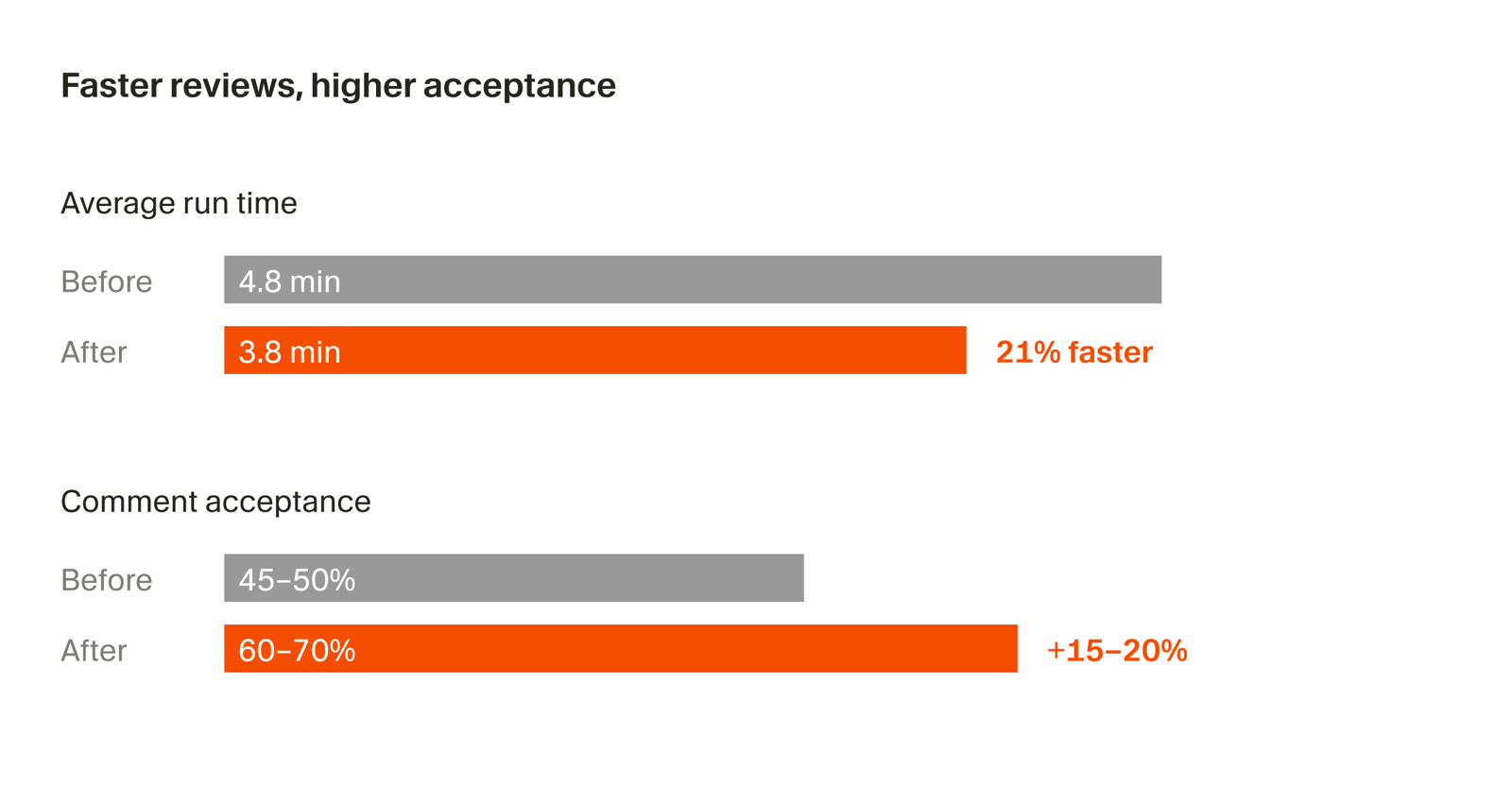
Cursor published before-and-after numbers from its own rollout: average review time fell from 4.8 to 3.8 minutes, and comment acceptance rose from 45 to 50 percent to 60 to 70 percent. Those are vendor numbers, not independent measurements.
The fine print
The bots are Teams and Enterprise only, which leaves independent developers and small projects on the free tier out. Both launched with a ten-day trial: Teams customers get credits covering roughly 50 code changes, Enterprise around 500. Post-trial pricing is not published. Rollouts also needs three connected systems before it does anything: source control, a deploy platform, and at least one observability tool. And Cursor notes the bots do not merge or roll back autonomously, so the risk is a wrong verdict, not an unauthorized action. ExplainX
The release is the first visible fruit of Cursor's Firetiger acquisition, the startup whose agents monitored software changes from pull request through deployment. Cursor frames both bots as steps toward what it calls self-driving codebases: agents that take over the repetitive, context-heavy work after the PR goes up, the part where, as Rustam Lalkaka puts it, "writing code is no longer the slow part."


