 Image: JetBrains Research
 JetBrains: 90% of Developers Now Use AI Coding Tools at Work, Claude Code Grew 6x in 8 Months
JetBrains surveyed over 10,000 professional developers in January 2026. GitHub Copilot still leads by install base, but growth has stalled. Claude Code grew from roughly 3% to 18% adoption in eight months and now ties Cursor. Its satisfaction score (91% CSAT, NPS 54) leads the market.
JetBrains published results from its January 2026 AI Pulse survey this week. More than 10,000 professional developers across eight languages and regions participated, with weighting applied for regional distribution, experience level, and JetBrains product familiarity.
The headline number: 90% of respondents regularly use at least one AI tool at work for coding tasks. That’s up significantly from where things stood a year ago, when many teams were still in evaluation mode.
Who’s Using What
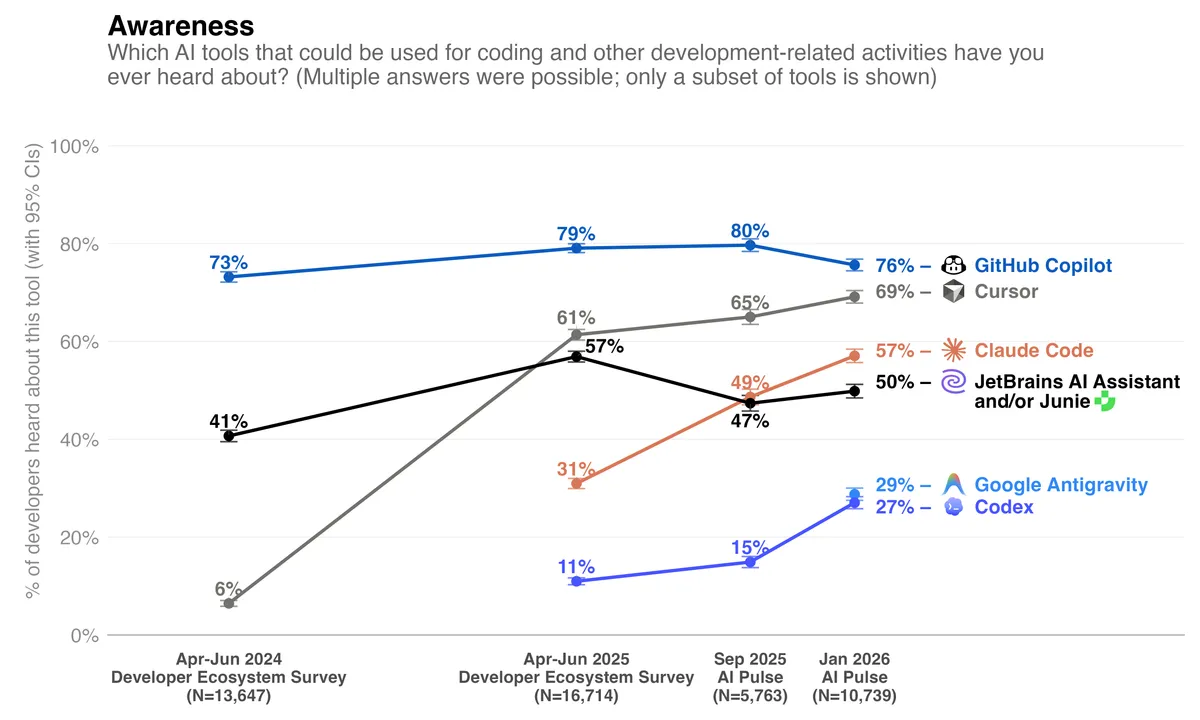
GitHub Copilot leads by install base. 76% of developers are aware of it, and 29% use it at work. But the growth has stalled. Copilot’s adoption is highest in large enterprises (40%), where it tends to be procurement-driven, but in smaller teams and individual developer usage, momentum has slowed.
Claude Code and Cursor are now tied at 18% work adoption. Both have about 69% awareness. The difference is trajectory. Cursor’s growth has been flattening in both awareness and adoption. Claude Code’s has not.
In January 2025, Claude Code had roughly 3% work adoption. Eight months later, it’s at 18%. That’s a 6x increase. In the US and Canada specifically, the number is 24%.
Google Antigravity, which launched November 2025, is at 6% adoption. OpenAI Codex sits at 3%, though the recent desktop update and computer use features will affect the next survey cycle.
JetBrains’ own tools (AI Assistant and Junie combined) account for about 14% active use among respondents.
Satisfaction
This is where Claude Code separates itself from the pack. It has a 91% customer satisfaction score and a Net Promoter Score of 54. NPS runs from -100 to +100; 54 is high for any software product, let alone one that competes against well-funded tools from Microsoft, Google, and OpenAI.
The survey doesn’t break down why satisfaction is high, but the pattern matches what you hear from Claude Code users: the combination of Claude’s instruction-following, the Remote Control and Routines features for async work, and the iterative pace of updates over the past six months have built up real goodwill.
What This Actually Means
The adoption race for AI coding tools is now clearly a three-horse competition: Copilot, Claude Code, and Cursor. Copilot has enterprise distribution and Microsoft behind it. Cursor has a $50 billion valuation and a loyal developer base. Claude Code has the fastest growth rate and the best satisfaction score.
None of these tools are slowing down in terms of feature velocity. Copilot shipped merge conflict fixing last week. Claude Code got a desktop redesign and Routines this week. Cursor 3 landed earlier this month. The pace of releases makes any single survey a snapshot, not a prediction.
The more durable finding from JetBrains is the overall adoption curve. Going from a minority practice to 90% regular use in roughly three years isn’t something you can attribute to a single product win. It means the tools have gotten genuinely useful for enough of the daily work that most developers stopped opting out.
Source: JetBrains Research