 Screenshot via TestingCatalog
 Google Is Building a Cowork Competitor Inside Gemini Enterprise
Leaked screenshots reveal a new Agent tab in Gemini Enterprise with task management, connected apps, file access, and a human review toggle. Here's what we know ahead of Google I/O.
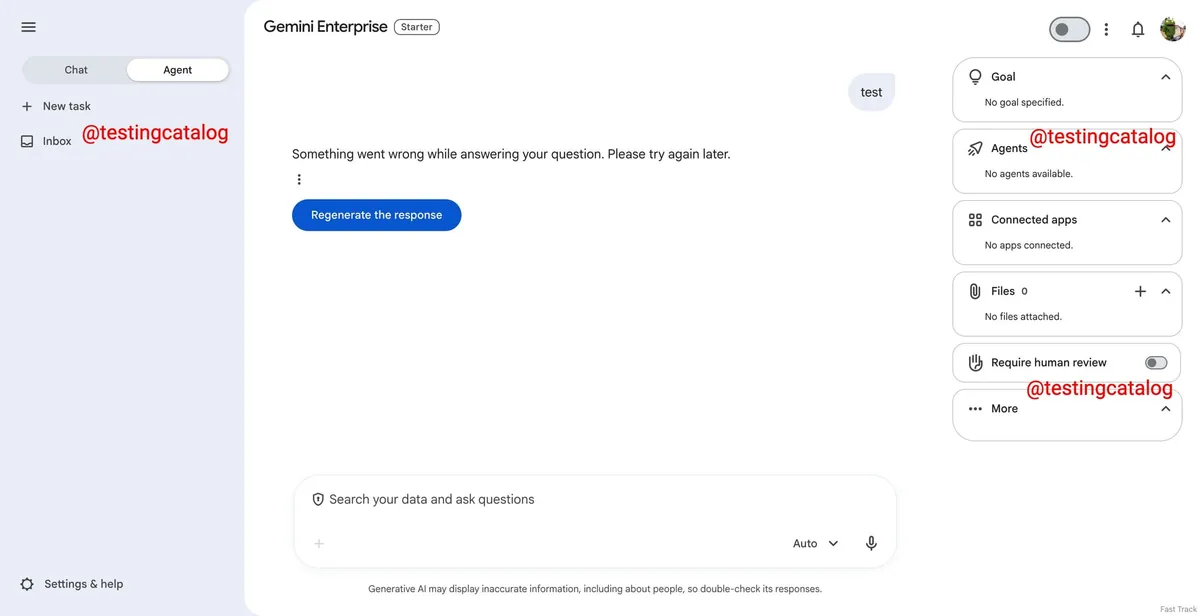
Google appears to be building a structured, task-driven agent system inside Gemini Enterprise. Leaked screenshots published today by TestingCatalog show a new Agent tab sitting alongside the existing Chat interface, complete with a task management UI that looks nothing like a chatbot and everything like a workflow execution platform.
The timing is hard to ignore. Google I/O 2026 kicks off on May 19, roughly five weeks from now. And Anthropic’s Claude Cowork has been steadily gaining enterprise traction since its launch earlier this year. Google, it seems, is preparing its response.
What the Screenshots Show
The leaked interface surfaces two entry points under the Agent tab: New Task and Inbox. When you create a task, a chat-style view opens with a right-side configuration panel containing five distinct sections:
- Goal — Define what the agent should accomplish
- Agents — Select which agent handles the work (currently showing “No agents available,” suggesting this is still early)
- Connected apps — Integrate external services and tools
- Files — Attach documents for the agent to reference
- Require human review — A toggle that, when enabled, requires approval before the agent takes action
There’s also a More section that’s collapsed in the screenshots, hinting at additional configuration options not yet visible.
The left sidebar reveals how this fits into the broader Gemini Enterprise experience. Alongside the Agent tab, you can see Tasks, Search, Library, Live, AI coding (marked “New”), Skills (marked “Preview”), Projects, and an Agents section listing Co-Scientist in preview. That’s a lot of moving pieces, all seemingly converging toward a unified workspace.
The Human Review Toggle Is the Tell
Most of these UI elements are straightforward project management scaffolding. The “Require human review” toggle is the interesting one.
A toggle like this only makes sense if Google expects the agent to take real actions with real consequences. Reading files and summarizing information doesn’t need human oversight. Sending emails, modifying documents, scheduling meetings, executing code, or interacting with third-party services through connected apps? That does.
This signals that Google’s Agent ambitions go beyond the conversational Gemini Agent already available to AI Ultra subscribers on mobile and web. That consumer product connects to Gmail, Calendar, Drive, and other Google services through natural language. What’s showing up in Enterprise looks more structured: explicit goals, agent selection, app integrations, and guardrails built into the interface from the start.
How This Compares to Claude Cowork
TestingCatalog explicitly frames this as a Claude Cowork competitor, and the comparison is fair. Cowork runs on Claude Desktop, executes code in an isolated virtual machine, breaks complex work into subtasks using parallel sub-agents, and produces real file outputs (spreadsheets, documents, presentations). It also has its own version of the human review concept, where Claude shows you what it plans to do and waits for approval before taking significant actions.
The parallels in Google’s leaked UI are obvious: goal-setting, agent selection, file access, connected app integration, and the human review toggle all map directly to Cowork’s feature set. The key difference, at least from what’s visible, is that Google’s version appears to be browser-based and tightly integrated with the existing Gemini Enterprise environment rather than running as a standalone desktop application.
Whether that’s an advantage or a limitation depends on your use case. Browser-based means no local setup and instant IT deployment across an organization. Desktop-based means deeper system access and local file operations. Both approaches have clear enterprise customers.
Part of a Bigger Push
This Agent feature doesn’t exist in isolation. TestingCatalog has been tracking several related developments in Gemini Enterprise over the past few weeks:
Skills (reported April 10) are reusable instruction sets that can be applied across Gemini conversations. They’re rolling out to consumer Gemini, Enterprise, and AI Studio. Think of them as saved prompts with structure, like custom GPTs but integrated at the platform level.
Projects are persistent workspaces in Gemini Enterprise with file uploads, Drive attachments, and drag-and-drop instruction setup. They’ve been in testing for months and appear in the leaked sidebar.
Multi-agent planning (reported March 10) was spotted in Gemini Business, where the system identifies the most relevant agent in a workspace, maps out a plan, and returns a delegation strategy. This sounds like orchestration infrastructure that would sit underneath the Agent tab’s “Agents” selector.
Taken together, these features suggest Google is assembling a complete agent platform: Skills define reusable behaviors, Projects provide persistent context, multi-agent planning handles coordination, and the Agent tab provides the execution interface. Each piece has been tested separately. I/O could be where they come together publicly.
What’s Still Unknown
The screenshots raise as many questions as they answer. The “Agents” field shows “No agents available,” which could mean the agent marketplace or selection system isn’t built yet, or simply that this test account hasn’t been provisioned. The “Connected apps” field says “No apps connected,” leaving open the question of which third-party integrations Google plans to support at launch.
There’s also the question of how this relates to Google’s existing agent infrastructure. The consumer Gemini Agent runs on Gemini 3.1 Pro and already handles multi-step tasks with Google services. Google’s Agentspace product targets enterprise search and action. And Firebase Studio offers a full-stack development environment. Whether the Enterprise Agent tab becomes a wrapper around these existing capabilities or something architecturally distinct isn’t clear from the screenshots alone.
The “Starter” badge visible in the top bar of the leaked interface suggests tiered access. Enterprise customers likely get more agents, more connected apps, or fewer restrictions on autonomous actions. But pricing and tier details are pure speculation at this point.
What to Watch For
Google I/O 2026 runs May 19-20. If this Agent tab is real and not just an internal experiment that gets shelved, expect Google to position it against both Claude Cowork and OpenAI’s Codex as part of the broader Gemini Enterprise pitch.
The race to build AI agent platforms that can actually do work, not just talk about it, is now a three-way contest. Anthropic shipped Cowork. OpenAI has Codex executing tasks in sandboxed environments. Google has the deepest integration story (Gmail, Drive, Calendar, Docs, Sheets, and everything else in the Google Workspace stack) but has been the slowest to ship a structured agent product to enterprise customers.
These leaked screenshots suggest that’s about to change.
Sources:
- Google develops its own desktop Agent to compete with Cowork - TestingCatalog
- TestingCatalog tweet - @testingcatalog, April 13, 2026
- Google prepares broader rollout of Skills for Gemini and AI Studio - TestingCatalog
- Google tests Multi-agent planning mode on Gemini Business - TestingCatalog
- Gemini Agent official page - Google
- Claude Cowork - Anthropic