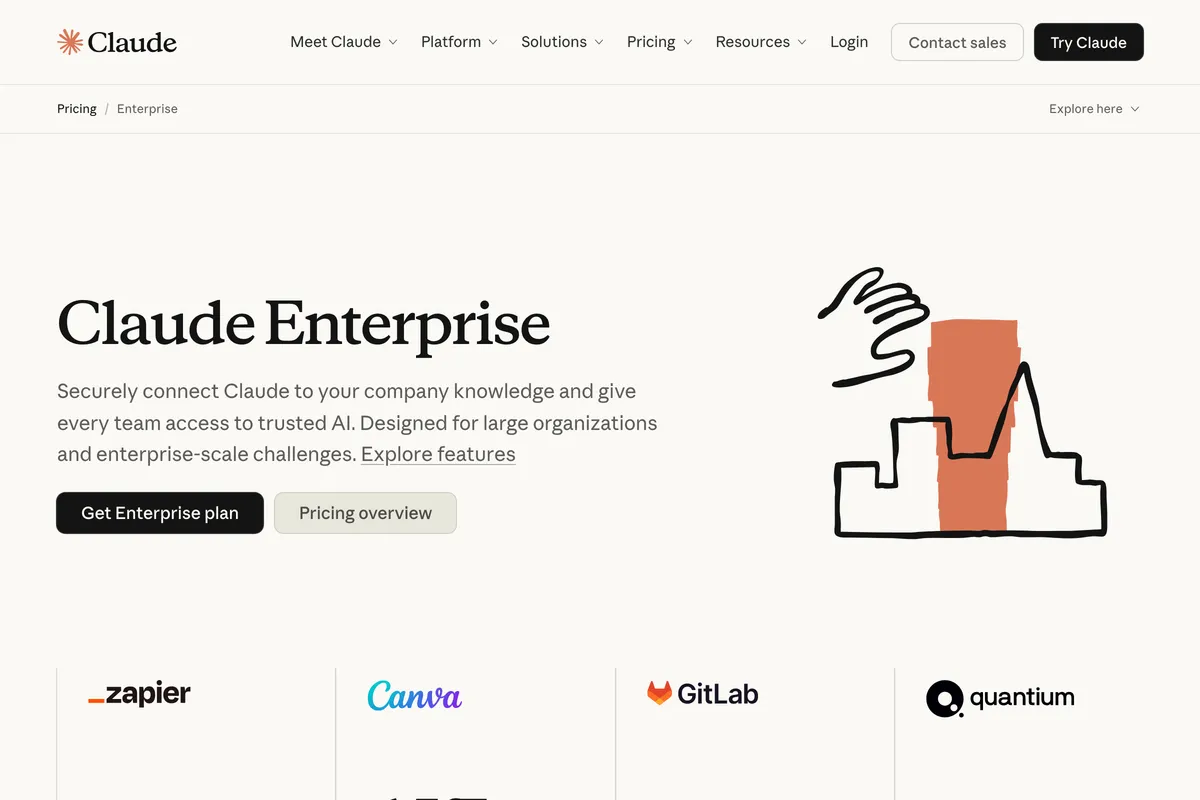
 Screenshot from claude.com/pricing/enterprise
 Claude Enterprise Has Been Usage-Based for Six Months. Today Everyone Noticed.
A First Squawk headline made it sound like breaking news, but Boris Cherny confirms Claude Enterprise switched to usage-based billing over six months ago. Here's what the model actually looks like.
A First Squawk headline hit feeds today: “ANTHROPIC SHIFTS TO USAGE-BASED BILLING, INCREASING COSTS FOR HEAVY USERS.” Within hours, the quote tweets were piling up. One user called it “clickbait bullshit” and pointed out it only applies to Enterprise customers, not regular subscribers. Then Boris Cherny, creator of Claude Code, replied with the real context: “And it’s been the case for over six months..”
So no, Anthropic didn’t just flip a switch today. Claude Enterprise has been running on usage-based billing since roughly October 2025. But the headline did surface a pricing model that many developers weren’t aware of, and the details are worth understanding for anyone whose company is evaluating Enterprise or already on it.
To be clear: this does not affect Pro, Max, or Team subscribers. Those plans still work the same way, with included usage at a fixed monthly price. This is strictly about Claude Enterprise.
Under the old Enterprise model, you bought a seat type (Chat, Chat + Claude Code, Standard, Premium) and got a block of usage included. Go over, pay extra. Under the current model, the seat fee is just an access pass. Every token, from the first one, is billed at standard API rates.
What the New Model Looks Like
Self-serve Enterprise starts at $20/seat/month, billed annually, with a minimum of 20 seats. That’s $4,800/year for the smallest deployment. Organizations buy credits upfront, and usage draws down from that balance. When credits run out, usage stops until you buy more.
Sales-assisted Enterprise requires a minimum of 50 seats with custom pricing negotiated directly. Industry estimates put these deals in the $40-60/seat/month range for large deployments, with 15-30% volume discounts typical for annual commitments above $100K. Sales-assisted plans get monthly invoicing against actual consumption rather than prepaid credits, plus HIPAA/BAA support, multi-currency billing, and tailored contracts.
In both cases, the seat fee covers access to Claude on web, desktop, mobile, Claude Code, and Claude Cowork. It does not include any usage. Every conversation, every Claude Code session, every Cowork task is metered at API rates on top of the seat fee.
The Token Rates
Enterprise usage is billed at the same rates as the API:
| Model | Input | Output |
|---|---|---|
| Opus 4.6 | $5/MTok | $25/MTok |
| Sonnet 4.6 | $3/MTok | $15/MTok |
| Haiku 4.5 | $1/MTok | $5/MTok |
Additional charges apply for specific features: web search costs $10 per 1,000 searches, code execution runs $0.05/hour (with 50 free hours daily), and Managed Agents cost $0.08 per session-hour. Prompt caching writes cost 1.25x the regular input rate, while cache reads are significantly cheaper ($0.50/MTok for Opus, $0.30 for Sonnet, $0.10 for Haiku).
What It Actually Costs Per Developer
Anthropic’s own cost documentation provides some useful benchmarks for Claude Code specifically:
- Average: roughly $13 per developer per active day, or $150-250/month
- 90th percentile: below $30 per active day
- Some third-party estimates are lower, around $6/developer/day with most staying under $12
These figures are for Claude Code usage only. Add in regular Claude chat usage, Cowork tasks, and web search, and the total per-seat cost can vary significantly depending on how heavily a team uses each surface.
The upside of this model is that light users cost almost nothing beyond the seat fee. A marketing team member who uses Claude for occasional writing won’t generate meaningful token charges. The downside is that a power-user engineer running Claude Code all day on Opus 4.6 can easily run up $400-600/month in token charges on top of their $20 seat.
Why Anthropic Made This Change
The old model had a structural problem: seat types with bundled usage created artificial constraints. A “Chat” seat couldn’t use Claude Code. A “Standard” seat ran out of usage faster than a “Premium” seat. Teams had to predict their usage patterns in advance and buy the right seat type, which meant either overpaying for headroom or constantly upgrading mid-cycle.
The new model eliminates that complexity. One seat type, everything accessible, pay for what you use. It also eliminates the inter-user competition problem. Under the old model, heavy users in an organization could drain shared usage pools, effectively reducing what was available to everyone else. With per-token billing, one person’s heavy usage doesn’t affect anyone else’s access.
Anthropic added cost control mechanisms to keep things manageable: organization-wide spend limits, per-user spend limits, and the new group-level spend limits announced in April 2026. Admins can set a ceiling for the engineering team that’s different from the ceiling for the sales team.
OpenAI Is Doing the Same Thing
This isn’t an Anthropic-only trend. OpenAI cut ChatGPT Business seats from $25 to $20/month in early April and switched Codex to pay-as-you-go token billing for teams. They introduced two seat types: standard ChatGPT Business seats with a Codex cap, and dedicated Codex-only seats with unlimited, token-billed usage. OpenAI also offered up to $500 in promotional credits per Codex-only seat to ease the transition.
ChatGPT Enterprise remains more expensive, estimated at $60/user/month with a minimum of 150 seats (roughly $108K/year minimum). But the direction is the same: separate the access fee from the consumption fee.
SiliconANGLE’s coverage of both moves on April 9 noted analyst Holger Mueller’s observation: “When vendors compete, enterprises win, as they get better capabilities at lower costs.”
The Transition for Existing Customers
If your organization is on a legacy seat-based Enterprise plan (Chat, Chat + Claude Code, Standard, or Premium seats), your current pricing holds until your next contract renewal. At renewal, you’ll transition to the unified Enterprise seat model with usage-based billing. The old seat types are no longer available for new contracts.
Self-serve Enterprise is available through AWS Marketplace as well as directly through claude.ai, which simplifies procurement for organizations that already have AWS billing relationships.
What This Means for Choosing a Plan
The pricing shift creates a clearer decision framework:
Claude Max ($100-200/month) makes sense for individual power users or very small teams who want predictable costs. You get a fixed monthly fee with generous (if vaguely defined) usage limits. No token math required.
Claude Team ($30/seat/month) works for small to mid-size teams who want the collaboration features without the Enterprise overhead. It includes usage allowances, so costs are more predictable.
Claude Enterprise ($20/seat/month + usage) makes sense when you need SSO, SCIM, audit logs, compliance controls, custom data retention, and fine-grained admin controls. The lower seat fee is attractive at scale, but you need to model your expected token consumption to compare total cost against alternatives.
For a 50-person engineering team where each developer actively uses Claude Code, the Enterprise math might look like: $1,000/month in seat fees plus $7,500-12,500/month in token charges, for a total of $8,500-13,500/month. That’s $170-270 per developer per month. Whether that’s cheaper than 50 Max seats at $100-200 each depends entirely on usage intensity.
The honest answer is that usage-based pricing is better for organizations with variable usage patterns and worse for organizations with consistently heavy users. Run your own numbers.
Sources:
- Claude Enterprise plan overview - Claude Help Center
- Enterprise billing - Claude Help Center
- Enterprise seat management - Claude Help Center
- Claude Enterprise pricing page
- Manage costs effectively - Claude Code Documentation
- Anthropic: Claude Code on Team and Enterprise plans
- Anthropic and OpenAI target big businesses with enterprise-grade controls - SiliconANGLE
- OpenAI switches Codex to pay-as-you-go, cuts seat cost - WinBuzzer
- Anthropic scales up Enterprise features for Cowork - 9to5Mac
- AWS Marketplace: Claude Enterprise