 Image: Zed Industries / zed.dev
 Zed Launches Delta, a Private Beta Multiplayer Environment Built Around AI Agents
The team behind Zed is building a separate product called Delta — a browser-based coding environment where code edits and agent conversations sync together in real time through a new database called DeltaDB.
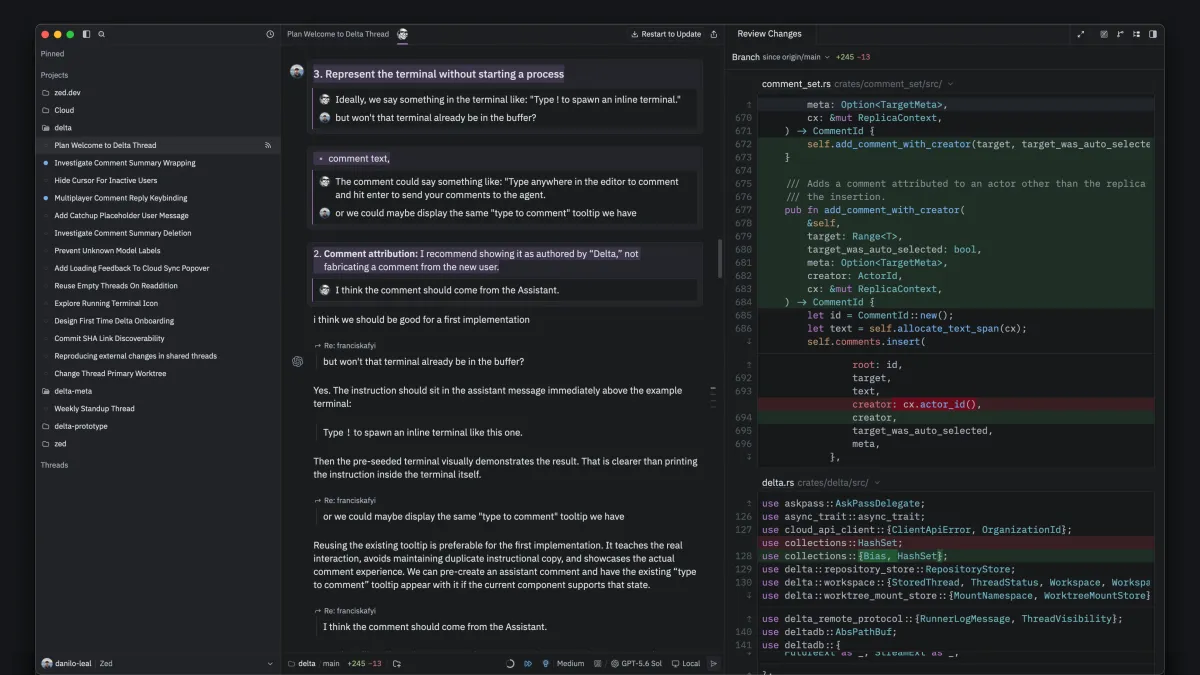
The team that built Zed has been quietly working on a second product. On August 12, 2026, they opened a private beta for Delta, described as “a multiplayer environment for coding with agents.” It runs in a browser, requires no installation, and is built around a sync engine they wrote from scratch called DeltaDB.
The problem Delta is trying to solve
Current AI coding workflows have a disconnect between where the code lives and where the conversation about the code lives. Your agent session is in one terminal, your git history is somewhere else, and the chat thread that explains why a change was made is usually nowhere at all.
Delta’s answer is to link them permanently. DeltaDB captures every edit operation between commits and ties each one to the agent conversation that produced it. If you open a file six months from now and want to know why a particular block looks the way it does, the conversation that generated it is attached.
DeltaDB
DeltaDB is the core. It’s a CRDT-based sync engine that replicates both the worktree and the conversation in real time. CRDTs (conflict-free replicated data types) let multiple writers — a human, an agent, and whatever else joins the session — make changes concurrently without the changes stepping on each other.
The Zed team describes it as being developed independently to avoid disrupting their existing user base. The plan is to eventually integrate DeltaDB technology into the main Zed application, but for now it lives in Delta as a separate platform.
Browser-based, no install
Delta is built in Rust and compiled to WebAssembly. It runs through WebGL in the browser. Zed is careful to say this isn’t a simplified JavaScript version — it’s the same Rust application rendered differently. For teams that don’t want to manage editor installs across developers and agents, the browser target removes a deployment step.
Agent compatibility
Delta uses the Agent Client Protocol (ACP), an open JSON-RPC standard introduced in August 2025. Agents that speak ACP can sync their sessions live into Delta threads while developers continue working in whatever terminal or editor they prefer. Current compatibility includes Claude Code, Codex CLI, Gemini CLI, Cursor, StackPack, and goose.
The ACP integration means you don’t have to switch to Delta as your primary editor. You run Claude Code in your terminal as usual, and the session appears live in Delta’s thread view.
Git compatibility
Teams that don’t use Delta see a normal git repository. Delta doesn’t impose a new workflow on collaborators who haven’t signed up. Standard git tooling works as expected.
Why a separate product
Nathan Sobo, who founded Zed, wrote about the vision in a September 1 post titled “Xanadu Was Waiting for Agents.” The piece connects Ted Nelson’s decades-old docuverse concept — a hyperlinked, always-connected information space — to what becomes possible when AI agents are doing most of the work. Nelson’s vision was always about linking information to its context and history. Sobo’s argument is that agents finally create the user base that concept was designed for.
The separate product decision seems to follow from that: Zed is an editor built around the human typing. Delta is built around the agent doing the work, with the human observing and steering. Those two things have different shapes.
Access
Delta is in private beta. The team is distributing invitations and said wider access would come in the weeks following the August 12 announcement. There’s no public waitlist link in the announcement, but the Zed website is the place to check.
Sources: