 Image: Temporal
 Temporal Raises $550M at a $12.55B Valuation to Sell Durable Execution to the Agent Boom
Temporal raised $550M at a $12.55B valuation on Sept 14 — more than double its February price — on $250M+ in annualized run rate and a bet that durable execution becomes mandatory infrastructure for AI agents.
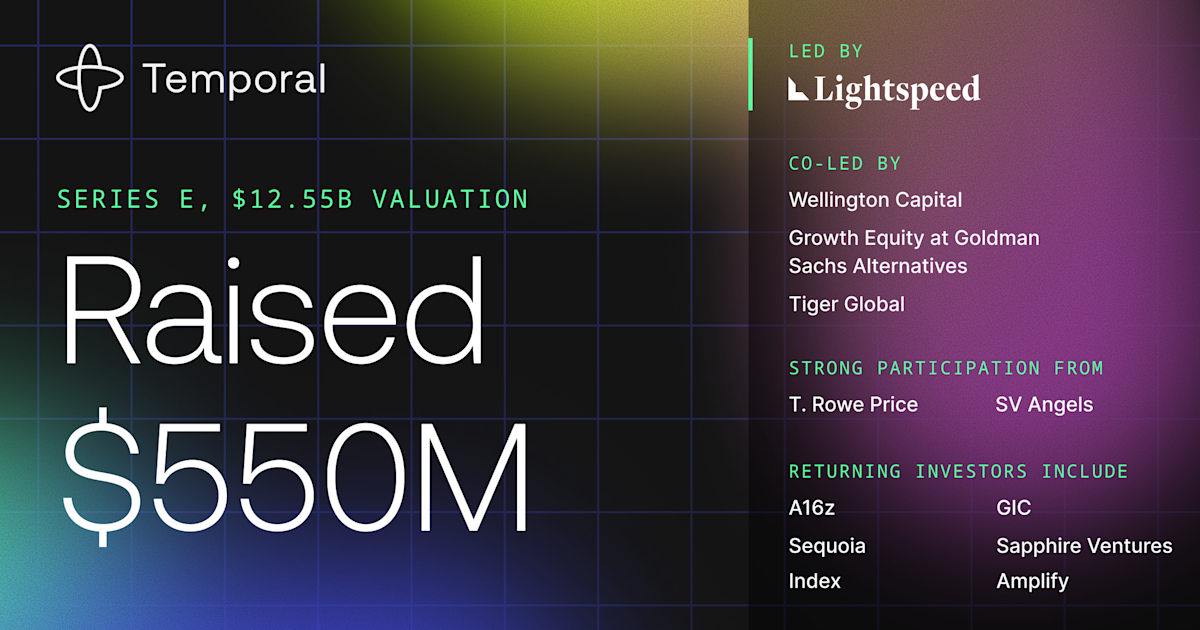
Temporal raised $550 million on Monday at a $12.55 billion valuation, more than doubling its price tag in seven months. The round was led by Lightspeed Venture Partners, with Wellington Management, Growth Equity at Goldman Sachs Alternatives, and Tiger Global as co-leads. Returning investors included Andreessen Horowitz, Sequoia Capital, and GIC. In February, the company was worth $5 billion after a $300 million round led by Andreessen Horowitz.
The numbers Temporal disclosed alongside the raise explain the repricing. Annualized revenue run rate has passed $250 million, more than tripling year over year. Temporal Cloud, the company's hosted version of its open-source engine, serves more than 4,300 customers — including OpenAI, Nvidia, Netflix, Snap, and JPMorgan Chase. In August, Temporal Cloud processed more than 1.9 trillion actions, and the open-source project logged over 43 million installs, according to company figures published Monday. Those install and action counts are Temporal's own reporting, not independently audited.
What Temporal actually sells
Reuters describes Temporal's software as recovery infrastructure: it helps applications, including AI agents, resume after failure instead of restarting from scratch, so engineers don't hand-write retry and state-recovery logic for every service. The open-source workflow engine is free; Temporal monetizes through Temporal Cloud, which hosts and operates it. The 570-person company says it will use the new capital to expand globally and fund platform research and development.
Why investors paid roughly 50 times run rate
A $12.55 billion valuation on a $250 million run rate is about a 50x multiple — a price that only makes sense if you believe durable execution becomes load-bearing infrastructure for the agent economy. Long-running agents are failure-prone by construction: API timeouts, rate limits, crashed containers, and interrupted runs. Every team running agents in production eventually builds some version of checkpointing and resume. Temporal's bet is that this layer consolidates into shared infrastructure rather than remaining bespoke code inside every company.
The funding climate supports the bet. AI companies accounted for 86% of U.S. venture deal value in the first half of 2026, according to the Pitchbook-NVCA Venture Monitor cited by Reuters. Money is concentrating in picks-and-shovels companies that sit underneath agent workloads, and Temporal — with OpenAI itself on the customer list — is positioned as one of them.
The open-source funnel is the story to watch
The gap between 43 million monthly installs and 4,300 paying Cloud customers is the entire investment thesis in one ratio. Open-source distribution gives Temporal enormous top-of-funnel reach; the question is how much of the agent-driven usage converts to hosted revenue. The tripling of run rate year over year suggests conversion is working so far. If agent deployments keep growing — and every funding round this year assumes they will — the recovery layer is one of the few places in the stack where spending is close to mandatory rather than discretionary. That's what $550 million is buying into.