 Image: OpenAI / community.openai.com
 OpenAI Opens the Agents API in Public Beta, Putting Codex's Harness Behind One API Call
OpenAI's Agents API gives every developer access to the orchestration infrastructure that powers Codex — durable sessions, context compaction, subagents, and nine sandbox partners — with no extra fee beyond token and tool usage.
OpenAI released the Agents API in public beta on September 10, 2026, making the orchestration infrastructure behind Codex available to any developer through a single API call.
The pitch is straightforward: instead of building your own session management, context compaction, and subagent coordination, you hand that plumbing to OpenAI and focus on what your agent actually does.
What the Agents API Does
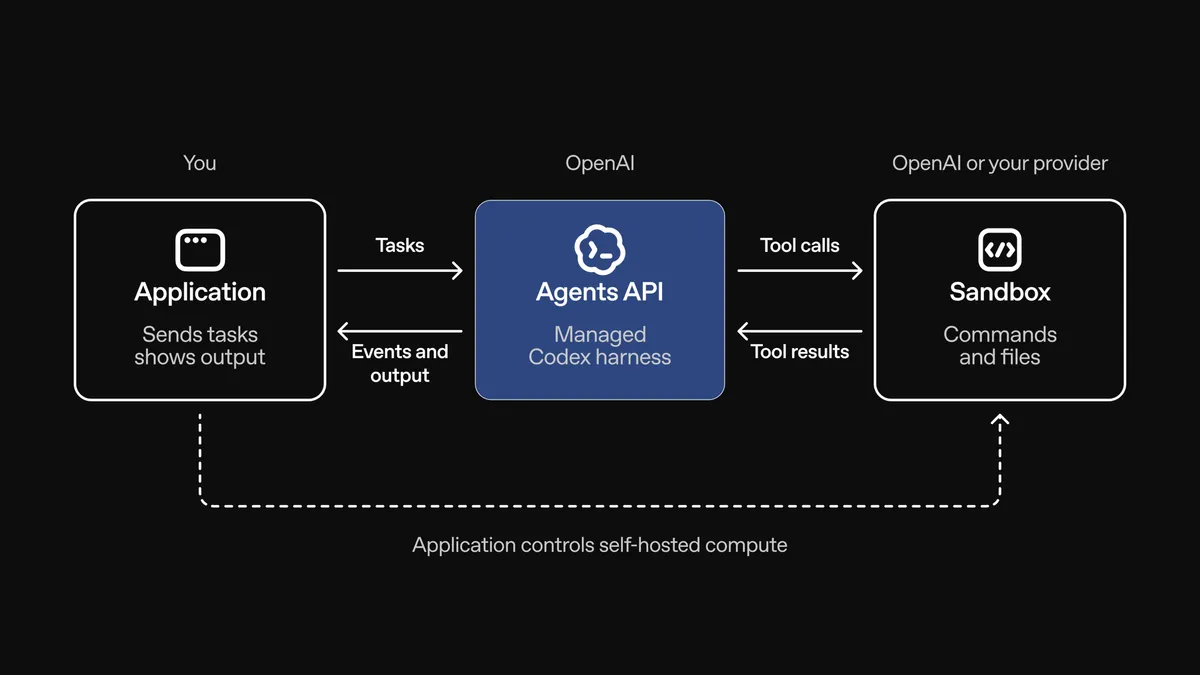
The API is organized around four concepts: an agent (model, instructions, tools, and any MCP servers it needs), an environment (an optional sandbox where the agent can run code and access files), a session (the durable instance that persists state across a long-running task), and events (the inputs and outputs streaming back to your application).
OpenAI runs the agent loop. That means handling context compaction when a session runs long, lazy tool loading to reduce token usage, parallel tool calls, and crash recovery. Developers supply the tools and pick where the code runs.
Subagent support is built in. An agent can spawn up to three concurrent subagents during a task, coordinate their work, and aggregate results without the developer writing that orchestration themselves.
Sandbox Options
Teams can run agent compute in one of three ways:
OpenAI-hosted sandbox: the fastest way to start. Uses the same sandboxing infrastructure that powers Codex. No setup required.
Self-hosted: run the execution environment on your own infrastructure using codex exec-server.
Partner sandboxes: nine providers are available at launch: Blaxel, Cloudflare, Daytona, DigitalOcean, E2B, Modal, Oracle, Runloop, and Vercel. These cover managed, cloud-native, and VPC deployment models.
Pricing
There is no additional fee for the Agents API itself. You pay for model tokens, tool usage, and sandbox compute time, same as you would when calling the API directly. The managed harness is included.
Early Customer Numbers
OpenAI shared results from three early access customers:
- Ciridae: evaluation score went from 0.71 to 0.85; latency dropped 4x.
- SafetyKit: per-case cost fell 60% after migrating to the Agents API.
- Hypha: failed agent responses dropped 86%.
These are vendor-reported figures from controlled rollouts, not independently verified benchmarks.
What It Is Not
Two notable gaps at launch: data residency is US-only, and Zero Data Retention is not supported. Teams with strict data locality requirements or compliance mandates will need to wait or run self-hosted.
The Agents API is available now to all developers. Documentation and the SDK are at platform.openai.com.
Source: Introducing the Agents API | OpenAI | OpenAI Developer Community announcement