AWS ships Strands Decider 2B, an open-source model that makes fast decisions for AI agents
Amazon's Strands Labs released a 2-billion-parameter open-source decision model that scores predefined options in about 115 milliseconds instead of generating text.
Amazon Web Services released Strands Decider 2B on October 1, an open-source model built for one job inside AI agent workflows: picking between predefined options quickly and reporting how confident it is. The release came out of Strands Labs, AWS's group for agent tooling, announced on the Strands Agents blog.
What it does
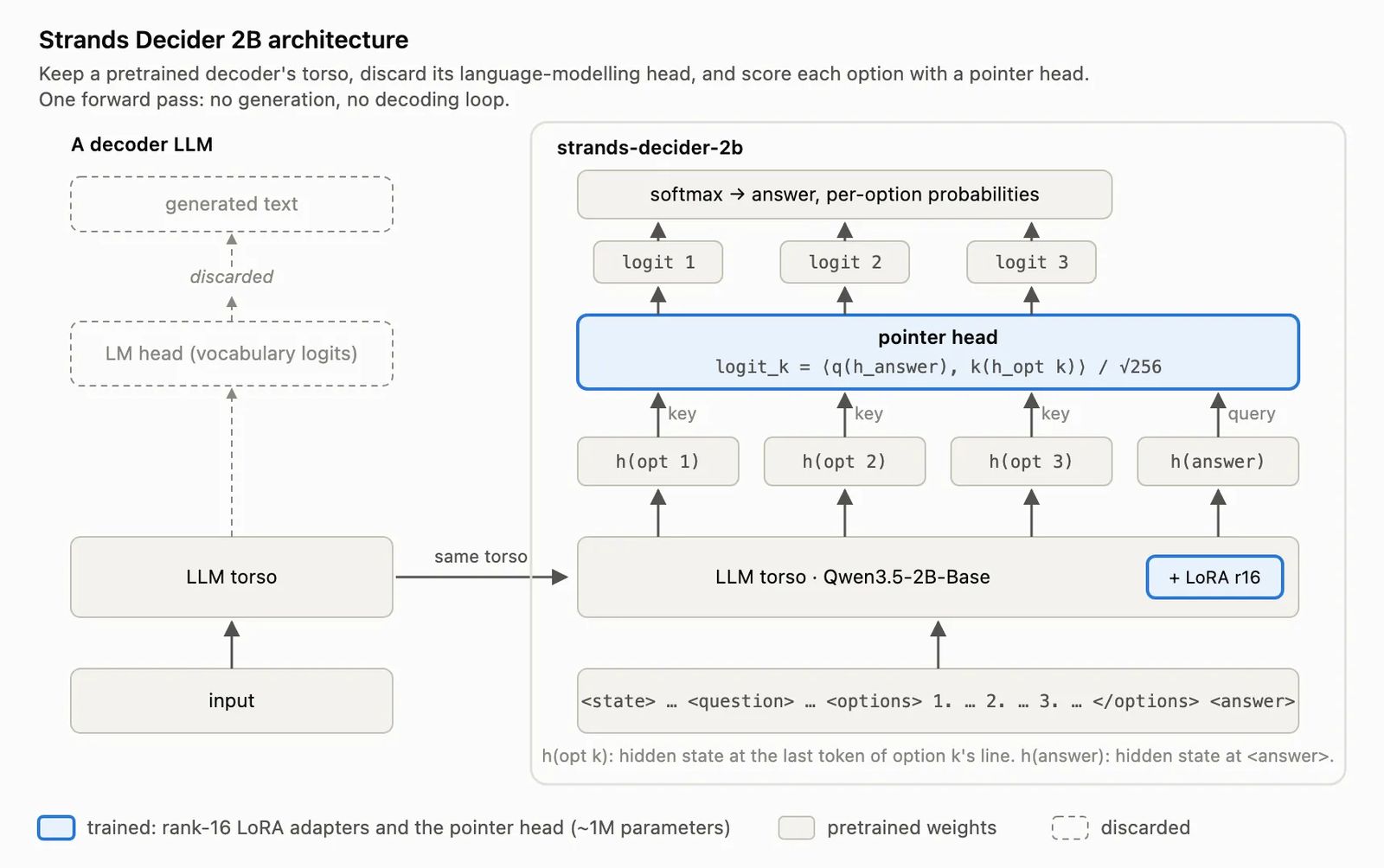
Decision models sit in a new category the industry has started calling "system one" models. Unlike a large language model that generates text token by token, Strands Decider 2B scores a set of supplied answers in a single parallel pass and returns the best fit. Typical uses include tool selection, request routing, guardrail checks, and deciding whether an agent should act or ask for help.
The speed is the point. AWS reports a median decision time of around 115 milliseconds on an Nvidia RTX 3090, and about 153 milliseconds for small tasks on an M3 MacBook. The model is built on the Qwen3.5-2B base, with the text-generation head removed and replaced by what AWS calls a "pointer head" of just over a million parameters, fine-tuned with a rank-16 LoRA adapter.
How it measures up
AWS tested the model on JevBench, a public benchmark for decision models, and reports it ranks third of 33 models in the 2-billion-parameter class on accuracy and calibration combined, and first among models that ship with a full training recipe. It scored perfectly on the benchmark's easy tier. As with any vendor-reported benchmark, treat those numbers as a starting point: the model is explicitly worse than reasoning models at complex problems, and its lack of text generation makes it unsuited for coding, chatbots, or document summarization.
Why AWS open-sourced the whole recipe
Everything is public: the weights are on Hugging Face, and the training data, scripts, and version history are on GitHub, where the team notes the shipping version is its 19th architecture iteration. There is no hosted API or per-call charge, so developers run it on their own hardware.
The timing is crowded. TypeSafe AI kicked off the category with Jev in September. OpenAI previewed a Decisions API at DevDay on September 30. Cloudflare followed with the open-source Clef model. AWS distinguished engineer Marc Brooker, who started the project after seeing Jev, told TechCrunch the motivation came from customers whose agent workflows did not always need the capability or the cost of a full language model for every decision step.
What this means for agent builders
The emerging pattern is hybrid: keep the large model for the hard reasoning, and put a cheap, fast decision model in the loop where an LLM call was never economical. Strands shows the pattern concretely with an example where the decider runs before a tool call to check whether the tool's arguments are actually grounded in what the user said, and whether calling it now would be premature. A decision that cheap can sit in a path where a frontier-model call never could.
For developers already building on the Strands SDK, strands-decider installs with pip and includes a CLI for asking choice questions directly. The Strands team says libraries for deeper decision-model integration are on the way.