 Image: Microsoft Security Blog / microsoft.com
 Microsoft Is Turning Its Bug-Hunting AI Into a Product. Here's What MDASH Actually Found.
MDASH, Microsoft's multi-model agentic security system, found 16 Windows vulnerabilities including four critical RCEs. Now Microsoft is commercializing it as Project Perception, targeting enterprises that can't afford Anthropic's Mythos.
Microsoft has been quietly running an AI security system called MDASH across its own codebase for months. The results were enough to justify turning it into a product. That product, reportedly called Project Perception, is expected to ship before the end of July.
What MDASH Actually Did
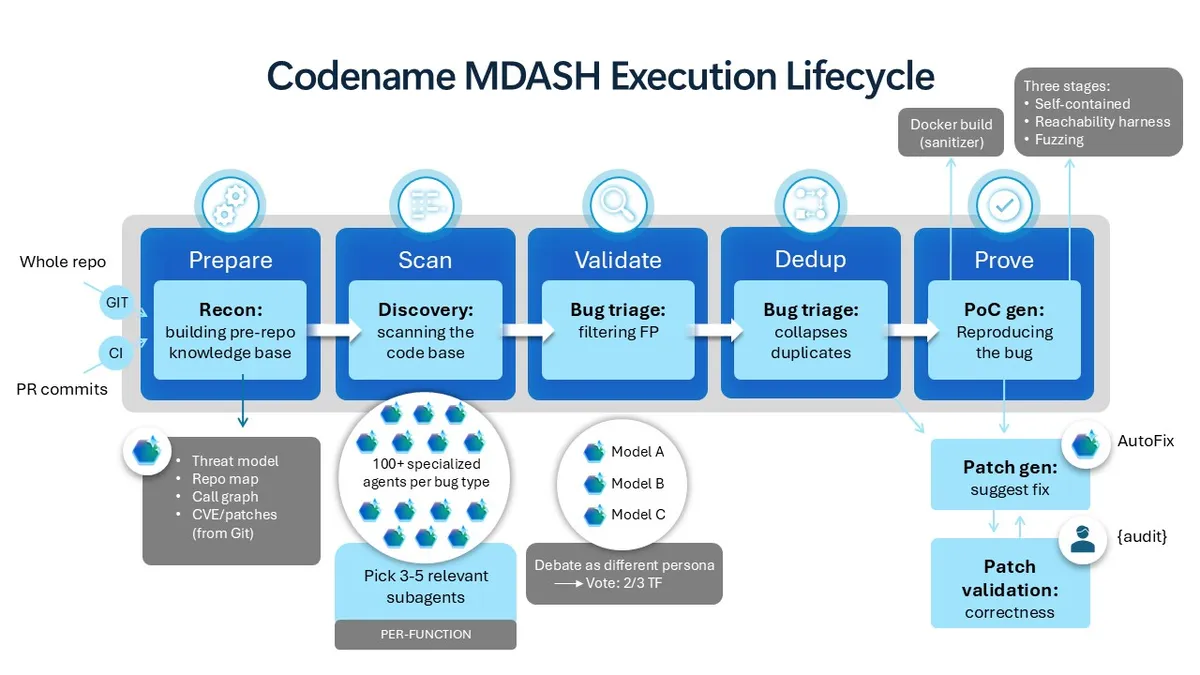
MDASH stands for Multi-Model Agentic Scanning Harness. It’s a five-stage pipeline built by Microsoft’s Autonomous Code Security team that coordinates more than 100 specialized AI agents across a mix of frontier and distilled models.
The pipeline runs like this: a preparation stage builds language-aware indices and threat models of the target codebase. Specialized auditor agents then flag candidate vulnerabilities. Debater agents argue for and against exploitability. A deduplication stage collapses semantically equivalent findings. Finally, a proving stage constructs and executes inputs that actually trigger the bugs.
The results from real use: 16 new vulnerabilities in Windows networking and authentication, including four critical remote code execution flaws. One was in the Windows kernel TCP/IP stack. Another was in the IKEv2 service. These aren’t theoretical findings — they’re the kind that end up in Patch Tuesday advisories.
On the CyberGym benchmark, which uses 1,507 real-world vulnerabilities, MDASH scored 88.45%. It found all 21 planted vulnerabilities in a StorageDrive test with zero false positives.
Taesoo Kim, Microsoft’s VP of Agentic Security, put it this way: “The harness does the work, and the model is one input.”
The Multi-Model Routing Part
The interesting architectural decision is how MDASH allocates model calls. Low-cost models handle triage, log parsing, inventory checks, and pattern deduplication. Frontier models from Microsoft, OpenAI, and Anthropic only step in for deep exploitability analysis and complex reasoning.
This separation means expensive inference is reserved for the work that actually requires it. High-volume scan passes run cheap. The system scales without the cost spiraling with it.
Project Perception: The Commercial Product
What Microsoft announced last week is that this same architecture is getting packaged into a standalone enterprise product: Project Perception. It scans code repositories, cloud infrastructure, endpoint telemetry, configuration databases, and software bills of materials.
No specific pricing has been announced. Microsoft has indicated it will be a separate SKU, not bundled into Microsoft 365 E5. No public waitlist has opened yet.
The timing matters. Anthropic’s Mythos essentially created the AI vulnerability-finding category, but access is tightly restricted — Anthropic has roughly 50 approved Project Glasswing enterprise partners. Microsoft’s angle is that a multi-model system can make this kind of work affordable and broadly available, not just rationed to a handful of large organizations.
What It Competes With
Mythos is built on Fable 5, Anthropic’s strongest model. The pitch from Microsoft is different: you don’t need the single strongest model to find bugs at scale. You need a system that routes work intelligently across models, reserves reasoning for where it counts, and runs the rest on something cheaper.
Whether that holds up when enterprises actually start comparing results is an open question. But Microsoft has the deployment surface that Anthropic doesn’t — it’s already inside the security stacks of most large enterprises.
Project Perception is still a few weeks from general availability. The underlying technology has already been working for months.
Sources: Microsoft Security Blog, TechCommunity Microsoft, TechTimes