 Image: GitHub / github.blog
 GitHub's HydraFusion Routes Between Multiple AI Models Per Coding Task
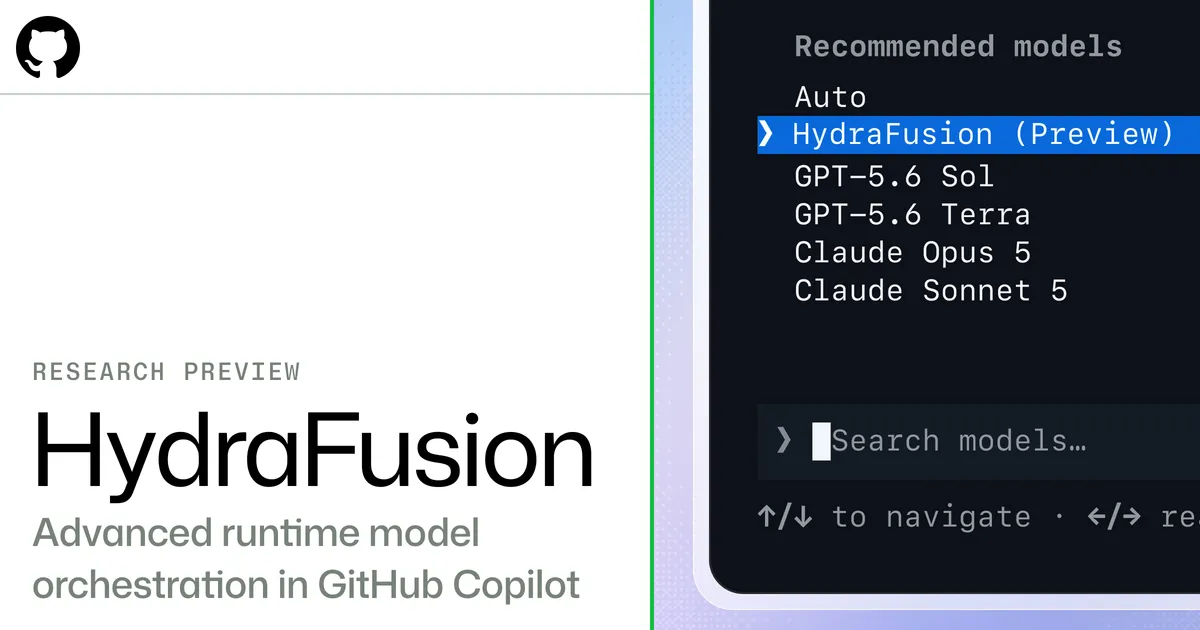
Project HydraFusion, now in experimental preview for Copilot CLI, picks a mix of models for each coding job at runtime — cutting estimated costs by 67% while matching frontier model quality on benchmarks.
GitHub shipped Project HydraFusion on September 4, 2026, as an experimental feature in Copilot CLI. The pitch: instead of routing every coding task through one model, HydraFusion picks a combination of models at runtime based on what the task actually needs.
The system is available now to all Copilot plans via /experimental in the CLI. Pricing is based on the token usage for whichever models actually run.
Three Routing Patterns
HydraFusion evaluates each task and assigns it to one of three execution patterns:
Single: one model handles the whole task. Used for straightforward requests where a capable model can produce the correct result directly.
Cascade: the task moves through increasingly capable models. A smaller model attempts it first; if the output doesn’t clear a quality threshold, a more powerful model takes over. Most tasks never reach the expensive end of the chain.
Critique: two models work together. One generates a solution; the other reviews and refines it. This pattern is reserved for tasks where the cost of a subtle mistake is high.
GitHub shapes the routing policy automatically, using capability-level scores across three benchmarks to pick policies that balance quality, cost, and failure rate. The policy search uses beam search to find configurations rather than manually tuned thresholds.
Benchmark Numbers
On TerminalBench 2.1, HydraFusion improved verified task completion by 4.9 percentage points compared to Claude Opus 5 running solo, at 67% lower estimated cost. On DeepSWE, estimated cost fell 36%. On CheckpointBench, it fell 65%.
The benchmark comparisons are against Claude Opus 5 as a reference, which GitHub cites as roughly equivalent to frontier-tier performance for coding tasks. Beating it on quality while reducing cost is the core claim.
A few caveats apply. Benchmarks measure specific task distributions; real-world performance depends on whether your tasks match that distribution. The cost estimates assume current model rates, which change. And “experimental” preview means the routing policies will almost certainly change before this ships as a stable feature.
What It Means in Practice
HydraFusion is currently CLI-only and behind /experimental. To use it, you select it as a model in Copilot CLI the same way you’d pick Claude or GPT-6 Astra. The routing is invisible to you — the system decides which models run.
One implication is that the effective cost per task becomes harder to predict in advance, since it depends on which pattern gets triggered. GitHub bills on actual token usage, so simpler tasks routed through smaller models cost less, while complex tasks that trigger Critique patterns cost more.
The broader direction here is clear: GitHub is betting that model routing, rather than picking one frontier model and sticking with it, is the right architecture for practical coding agents. The quality-per-dollar math, at least on benchmarks, supports that bet.
Sources: GitHub Blog, MarkTechPost