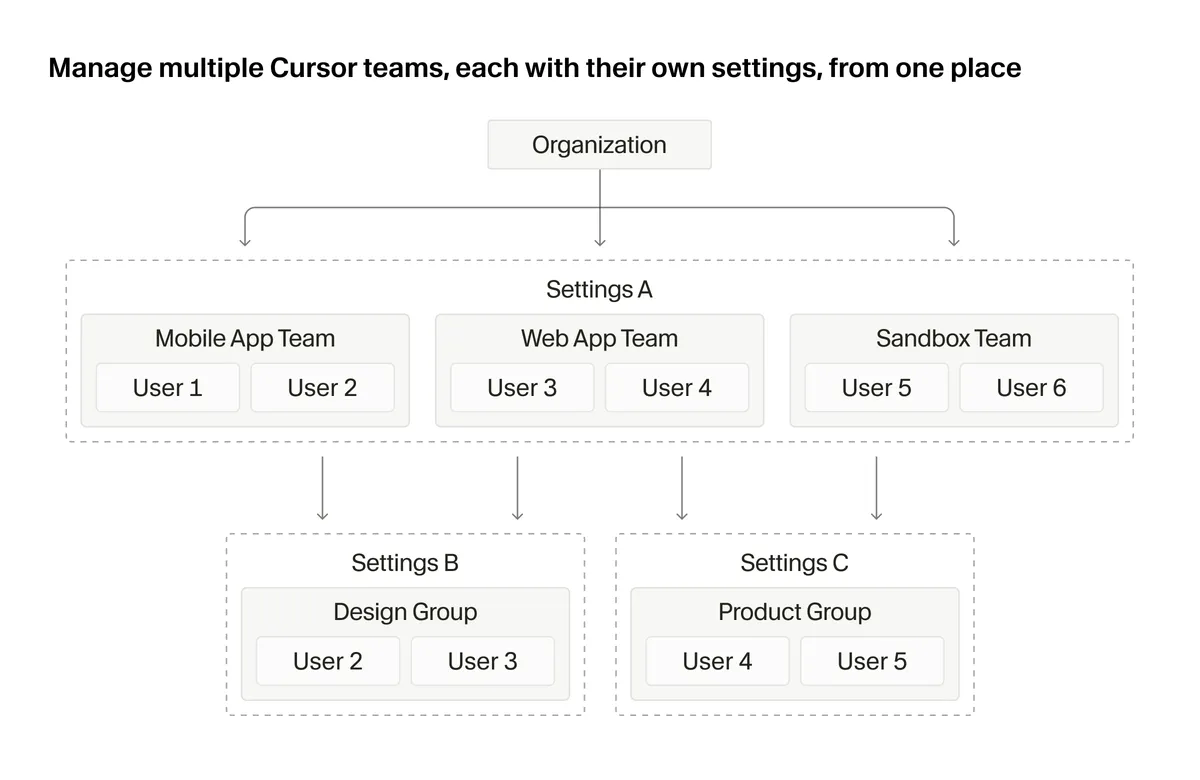
 Diagram from cursor.com/changelog/enterprise-organizations
 Cursor Enterprise Gets Organizations: One Admin Panel for All Your Teams
Cursor's June 3 update adds Organizations for Enterprise customers: a top-level container for managing multiple teams with separate security, governance, budget, and model controls. Users can belong to more than one team, with different roles in each.
Cursor shipped Organizations for Enterprise customers on June 3, adding a new top-level administrative layer above the existing Teams structure.
Before this update, Enterprise customers managed everything at the team level. That works when a company runs one Cursor deployment, but it gets awkward when different divisions, regions, or business units need separate configurations. Organizations is the answer to that.
What Organizations Actually Is
The structure now has three tiers.
Organizations sit at the top. They hold the company identity and give admins a unified view of spend and token usage rolled up across every team under the org. Security and compliance settings at the org level propagate down unless overridden.
Teams are the operating units. Each team can have its own security settings, governance rules, budget limits, and model access. A company with a core engineering team, a data science team, and a contractor pool can run each as a separate team with different permissions and spending caps.
Groups are lighter-weight. They let admins create collections of users that span teams without setting up a full parallel team structure. The use case is something like giving a subset of engineers across multiple teams access to a specific model or a higher spending limit without reorganizing anything.
A user can belong to more than one team with a different role in each. When they have conflicting permissions across memberships, the most permissive setting applies.
Why This Matters for Large Deployments
Most of the AI coding tool market has been focused on individual developer experience. Enterprise tooling, specifically the administrative layer that makes it possible to roll out Cursor to 5,000 engineers with different access levels and cost centers, has been thin.
Organizations moves Cursor meaningfully in that direction. The ability to separate budget controls by team, require different security postures for contractors versus employees, and see aggregate spend across the whole company from one place is what procurement and IT teams need before approving large-scale deployments.
It also matches what competitors have been building. GitHub Copilot’s enterprise controls have been a selling point for years. Cursor is closing that gap.
Access
Organizations is generally available for Enterprise plan customers as of June 3. Teams and Groups remain available on lower-tier plans, but the Organizations container layer is Enterprise-only.
Source: Cursor Changelog, June 3, 2026